A new DeepSeek release, with two practical questions
DeepSeek has a new update. DeepSeek-V4.1-Flash-1017 arrived on October 17, 2026, with the website, app and API upgraded together. It builds on V4.1 Flash, emphasizing coding and agent performance, task duration and output length. DeepSeek also opened Search and Fetch APIs backed by its own search engine. Official announcement.
The striking result is the upper-left corner of DeepSeek’s official performance–cost chart: the 1017 model reaches a 77% pass rate at its highest effort for roughly $0.2 per task. Higher success and lower cost arriving together are the reason to revisit DeepSeek. Start with that chart, then examine project development, retrieval tools and the actual bill.
Keep the release dates separate. V4.1 Flash launched on September 10, already introducing the new architecture and native vision. The 1017 release is a follow-up. The September announcement and current changelog distinguish the scope of the two releases. This article interprets official information checked on October 17; it is not an independent model benchmark.
The key chart: higher success at much lower task cost
Within this official chart’s evaluation scope, DeepSeek 1017 has a pronounced performance–cost advantage. The dark-blue curve sits in the upper-left: higher means more tasks pass, while further left means less money per task. The update moves both measures in a favorable direction.
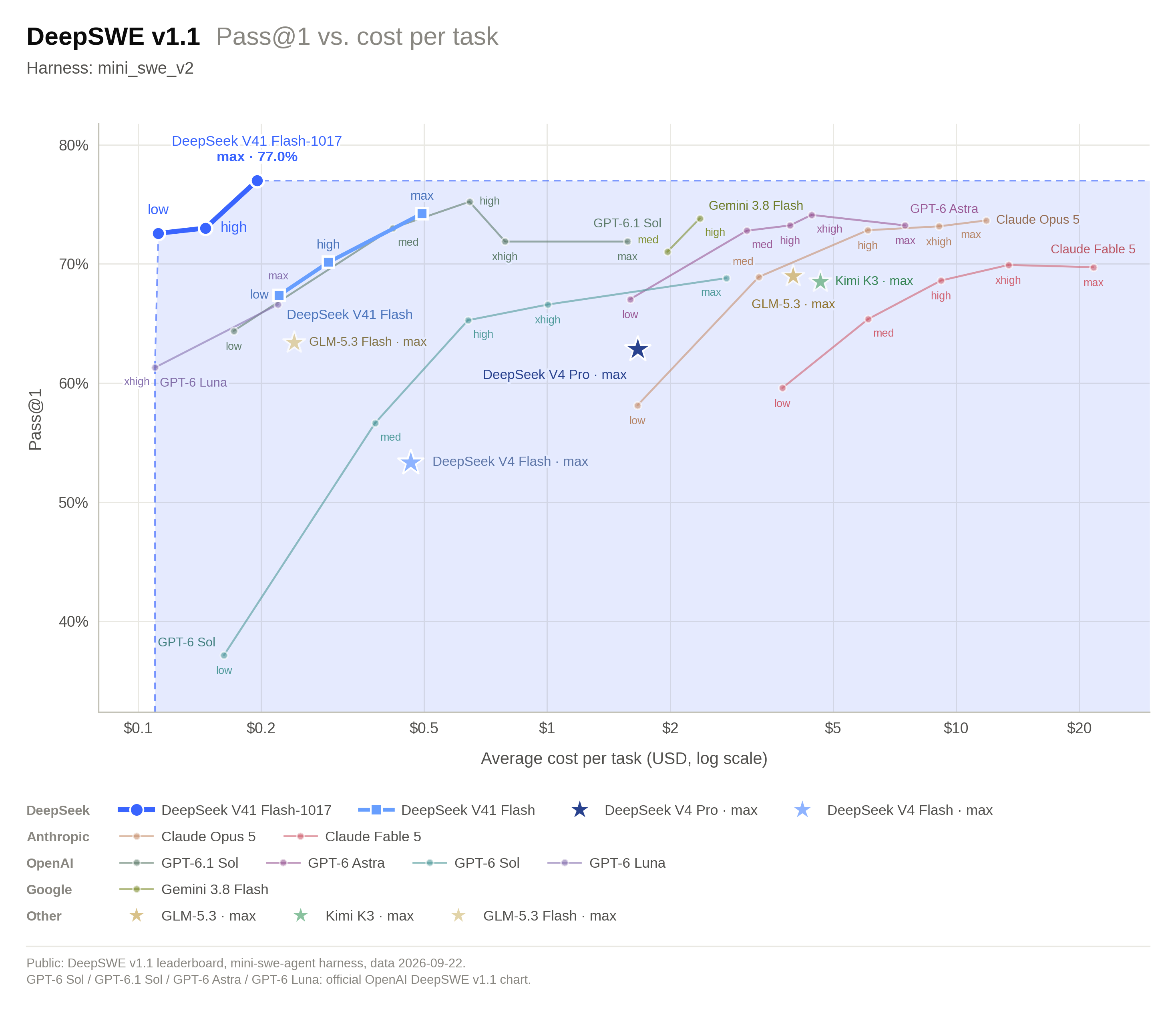
Source: DeepSeek’s October 17 release. The complete official figure, axes, legend and footnotes are retained. Select it to open the full-resolution image.
Three details explain the size of the change:
- The top setting is stronger and cheaper together. The 1017 max point is labeled 77.0%, at roughly $0.2 per task. The preceding V4.1 Flash max point is 74.2%, near $0.5. Reading those positions approximately, the higher-scoring result costs about 40% as much. This is a chart estimate, not a measured bill from our own tasks.
- Some cost gaps exceed tenfold. Several higher-effort GPT‑6 Astra and Claude Opus 5 points sit around 73–74% while costing several dollars to more than ten dollars per task. Against those displayed operating points, the cost gap exceeds a factor of ten. GPT‑6 Luna also has an inexpensive point, but a lower pass rate: both axes matter.
- The horizontal scale is logarithmic. $0.2 to $2 and $2 to $20 are each a tenfold increase. A modest-looking horizontal separation can represent a large budget difference. That is why this figure says more than a score-only leaderboard.
My interpretation is that DeepSeek has moved the coding performance–cost curve substantially toward the upper-left. If a team sees a similar pattern on its own repositories, it can afford more checking, repair and alternative-solution runs. Lower cost and stronger capability can become a combined reason to choose the model.
Keep the comparison set explicit. This is an official DeepSWE v1.1 compilation; the 1017 result names mini-swe-v2. The footnote cites public leaderboard data dated September 22 and an official OpenAI chart, rather than a same-day rerun of every model by us. The Claude entries are Opus 5 and Fable 5, so the figure does not establish a win over every newer release or every business task. Within those boundaries, the displayed combination is strong enough to make 1017 a serious candidate for a coding-model trial.
What changed in 1017, and what was already available
| Question | What the release establishes |
|---|---|
| Is this a new model generation? | The model card describes a minor update to V4.1 Flash. |
| What is the focus? | Coding agents, complete projects from scratch, task duration and output length. |
| Is a new API model ID required? | Continue using deepseek-flash, which now serves 1017. |
| Are vision and 1M context new today? | These are existing capabilities, not first introduced in this update. |
| What separate services launched? | Public Search and Fetch APIs. |
Sources: 1017 model card, model specifications and prices, and Search and Fetch guide.
This also affects comparisons. Calling deepseek-flash and the legacy deepseek-v4-flash today does not create a new-versus-old test: the pricing documentation says legacy Flash IDs also route to 1017. Use saved earlier runs or an environment that actually pins the older version.
Read coding scores within the same evaluation
These five official results cover development and reasoning. The final column subtracts the reported scores; it does not measure an equivalent percentage improvement in workplace productivity.
| Official evaluation | V4.1 Flash | 1017 | Score change |
|---|---|---|---|
| HLE, without tools | 36.8 | 42.6 | +5.8 |
| Terminal-Bench 4.0 | 31.2 | 42.3 | +11.1 |
| DeepSWE v1.1 | 74.2 | 77.0 | +2.8 |
| ProgramBench | 20.3 | 29.1 | +8.8 |
| NL2Repo-Bench | 65.4 | 68.2 | +2.8 |
Source: official model-card evaluation table. Terminal-Bench 4.0 uses the Claude Code harness; DeepSWE uses Mini-SWE-V2. The HLE row retains the full no-tools result rather than the text-only subset's 44.0. Different harnesses, permissions and benchmark versions should not be merged into a single ranking. Evaluation conditions.
For developers, improvements across terminal tasks and project building are a useful reason to try the model. They do not establish that every repository can be changed correctly in one attempt. The earlier performance–cost chart explains why success rate and the cost of completing a task should be read together.
What a complete project should have to pass
DeepSeek frames the release around wish-driven programming and attributes project improvements to reinforcement learning with self-feedback. Its examples include Forbidden City 3D modeling, a browser racing game and a Godot game project. These are official demonstrations inside DeepSeek Harness. They show the intended task category; footage alone cannot establish reliability across devices or replace code and functional review. Official demonstrations.
Try a smaller task with observable acceptance criteria. Here is a proposed exercise, not a run we performed: build an event registration page from an event time, a 20-place capacity, a list of fields and a layout reference. Require a mobile layout, email validation, a full-capacity state and a persistent confirmation.
The difficult questions appear after the page looks finished. What if two people claim the last place simultaneously? Does the registration survive a refresh? Can a failed submission be retried without consuming capacity twice? A frontend demonstration should state that it lacks persistence or concurrency protection if those pieces are absent. A working button does not establish a usable registration system.
Write those checks before starting the task. Record time to the first runnable version, failed checks, correction rounds and the final result. Visual quality, functional correctness and readiness to deploy are separate outcomes; measuring them separately reveals what the model actually improved.
Search and Fetch connect research to source material
Alongside the model, DeepSeek opened two web tools. Search finds pages and returns structured results; Fetch extracts a specified page as Markdown. Both use a DeepSeek API key, at POST /v1/tools/search and POST /v1/tools/fetch. Official interface guide.
Consider a supplier product-update brief. This original workflow illustration describes a proposed process, not an API test:
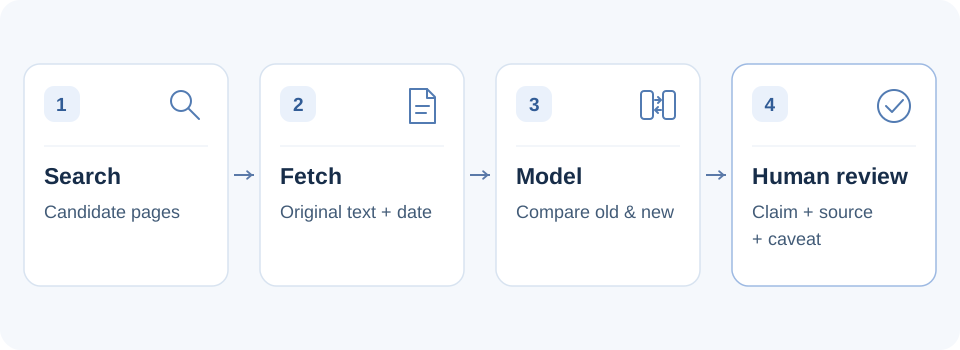
Original Onevium illustration. Search results are evidence candidates; conclusions still need to match the original sources.
Suppose a search summary says a model became cheaper. The source page reveals that the price cut happened in September, while today's announcement changes capabilities. A useful brief separates those two events. A page without a confirmed publication date stays unresolved rather than becoming today's news. If Fetch cannot retrieve a page, a search summary should not silently become a verified quotation.
The APIs make retrieval and source acquisition composable, helping developers retain dates and provenance. They do not independently validate every claim, and they are not a browser that can sign into arbitrary sites or operate forms. Fetch remains subject to the target site's availability and access policies.
The competitive implication is the combination of inference and evidence acquisition: a team can evaluate generation costs and retrieval costs in the same workflow. Whether that service becomes a lasting choice depends on recall in its subject area, freshness, source quality and accepted task results. Index size alone cannot answer those questions.
Unchanged rates can still produce a different task bill
These are the official USD prices per million tokens checked on October 17, 2026, separate from consumer app subscriptions. The 1017 update keeps the current Flash rates.
| Billable category | Off-peak | Peak |
|---|---|---|
| Input, cache hit | $0.003 | $0.006 |
| Input, cache miss | $0.15 | $0.30 |
| Output | $0.60 | $1.20 |
Peak hours are 01:00–04:00 and 06:00–10:00 UTC on weekdays, excluding Chinese public holidays. All other hours are off-peak. Source: DeepSeek pricing. The Chinese edition of this article uses the provider's published RMB rates, not a currency conversion.
For a reproducible hypothetical calculation, assume all turns together consume 100,000 uncached input tokens, including retrieved text and repeated context, plus 10,000 billable output tokens in off-peak hours. Model charges are 0.1 × 0.15 + 0.01 × 0.60 = $0.021. Reducing output to 6,000 tokens with everything else held constant gives $0.0186. The token counts are invented to explain billing, not measured model savings.
Search and Fetch each cost $0.75 per 1,000 successful requests. Only HTTP 200 responses with results are billable; empty searches, errors and timeouts are not. Four successful searches and six successful fetches add 10 / 1,000 × 0.75 = $0.0075, bringing the first example to $0.0285. This retains the assumed totals across all turns. In real billing, count context resent on each turn rather than only the final visible answer. Search billing rules.
One transition date matters: existing server-side Search and Fetch tool calls through DeepSeek Harness, Claude Code or Codex using the DeepSeek API are currently unbilled. Per-request charging begins November 1, 2026 at 00:00 Beijing time, or October 31 at 16:00 UTC. This applies to those specified calling paths, not an unlimited free offer for every use of the new APIs. Billing documentation.
Human review and rework sit outside that token bill. Shorter output that omits required work may be more expensive to finish; a longer answer that passes review may be cheaper overall. Divide total costs by accepted outcomes when comparing models, rather than stopping at token rates.
Open weights and a practical first trial
The 1017 weights are available on Hugging Face and ModelScope. The official model card assigns the repository and weights an MIT license. Open weights offer a route to deployment and research; they do not imply that an ordinary laptop can run the model or that all training data and processes are public. Check inference support and resource requirements before planning a deployment.
Individuals can try the official website or app. API users should verify deepseek-flash. DeepSeek recommends Harness 0.2.1-rc.1 or later for its own agent environment. Integration note. If you use a third-party gateway, ask which upstream version it serves rather than relying on a display name.
In Onevium, the custom provider guide explains the existing DeepSeek connection. The Anthropic-compatible base URL is https://api.deepseek.com/anthropic, with model deepseek-flash. Keep an already verified preset or configuration, check a short response, then have the model read and accurately summarize a test file before attempting a small project with explicit acceptance checks. This article has not independently validated the complete 1017 toolchain in Onevium; the model update also does not establish that the new Search and Fetch APIs are automatically connected.
The release makes DeepSeek worth another trial for coding and research. Use the same inputs, tool permissions and acceptance checks across candidates, then record charges, elapsed time and corrections before changing your default. For a deeper comparison method, continue with model prices and benchmarks and reviewing AI execution traces.