What REA adds to reverse engineering
REA's central strength is turning the capabilities of professional reverse engineering tools into evidence that an AI agent can investigate, cross-check and reuse. It makes “How does this feature actually work?” a question that can be pursued step by step: find a lead, follow it across modules and processes, gather more evidence where the explanation is uncertain, then test the explanation against concrete results.
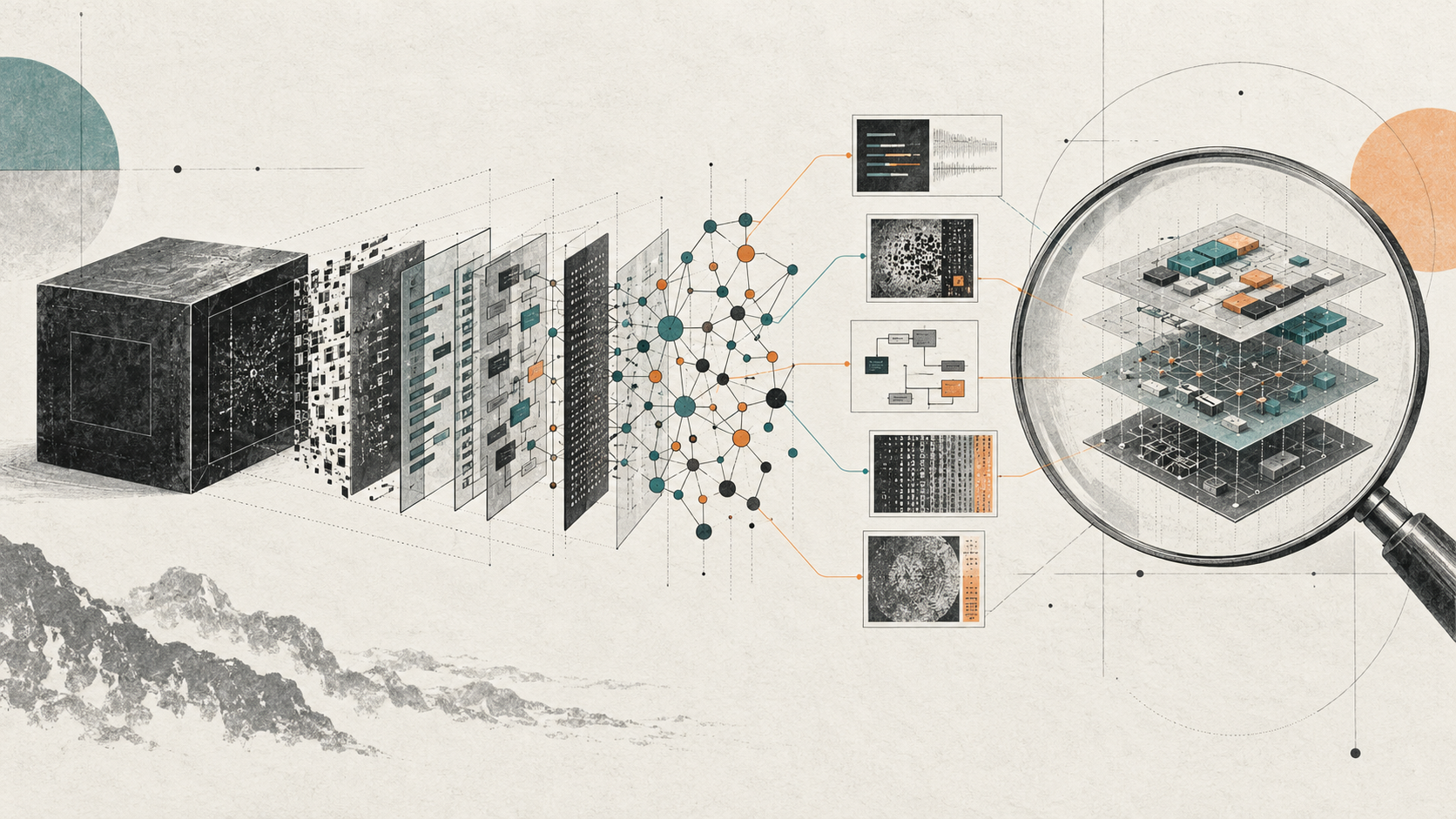
As of October 14, 2026, GitHub's official figures for morluto/rea were approximately 228,600 stars and 56,800 forks. That attention makes the project worth examining; it does not establish how well its reverse engineering works. The more revealing questions concern incomplete decompilation, complex application layers, oversized results and a model's tendency to infer more than the evidence supports. REA on GitHub
Three roles help explain the architecture. The underlying analysis engines disassemble, decompile or read particular formats. REA connects those engines, invokes them, organizes results and manages evidence. The agent asks questions, chooses the next step, interprets results and writes reconstruction code. Deep analysis of native binaries depends on established tools such as Hopper, Ghidra or IDA; targets such as JavaScript have separate static analysis paths. Much of REA's technical value lies in connecting these capabilities. Architecture source
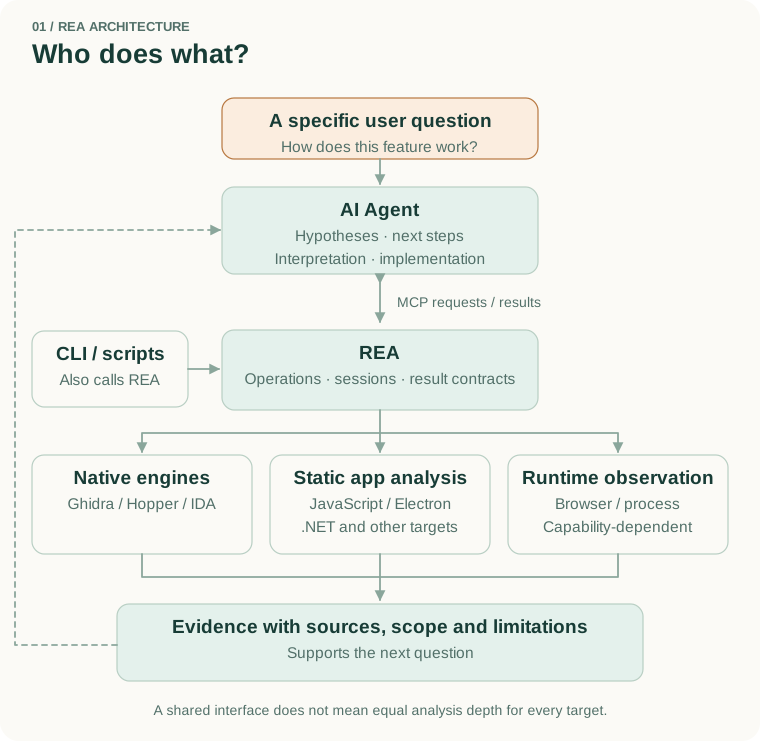
Figure 1. The division of responsibilities in REA. A unified entry point does not give every target the same depth of analysis.
Begin with a question that evidence can answer
REA first changes the starting point of an investigation: a researcher can begin with a question, then use the tools needed to answer it. Reverse engineering involves more than understanding an assembly instruction. It also means finding entry points and cross-references, moving between tools and assembling local observations into a coherent explanation. REA's investigation Skill asks the agent to break down the question, identify the evidence it needs, start with a small overview and follow hypotheses. It should widen the scope when a specific gap appears, then mark questions as answered, partially answered or unresolved. Investigation workflow
This reduces the work of organizing an investigation. Suppose the question is “Which formatting survives when rich text is copied?” A useful investigation follows clipboard interfaces, call relationships and data transformations. Reading every function in the application would add substantial work without necessarily answering that question. These design choices suggest that REA is especially useful for progressively investigating a clearly defined feature. A specific target makes the returned material easier to use for verification.
There are two distinct implementation layers here. Skills and guided prompts provide investigation discipline, but they do not automatically execute a fixed workflow or guarantee that the model follows it. Server contracts and code constrain the structure of results and some comparison outcomes. An accurate assessment of REA needs to keep those layers separate. MCP prompts
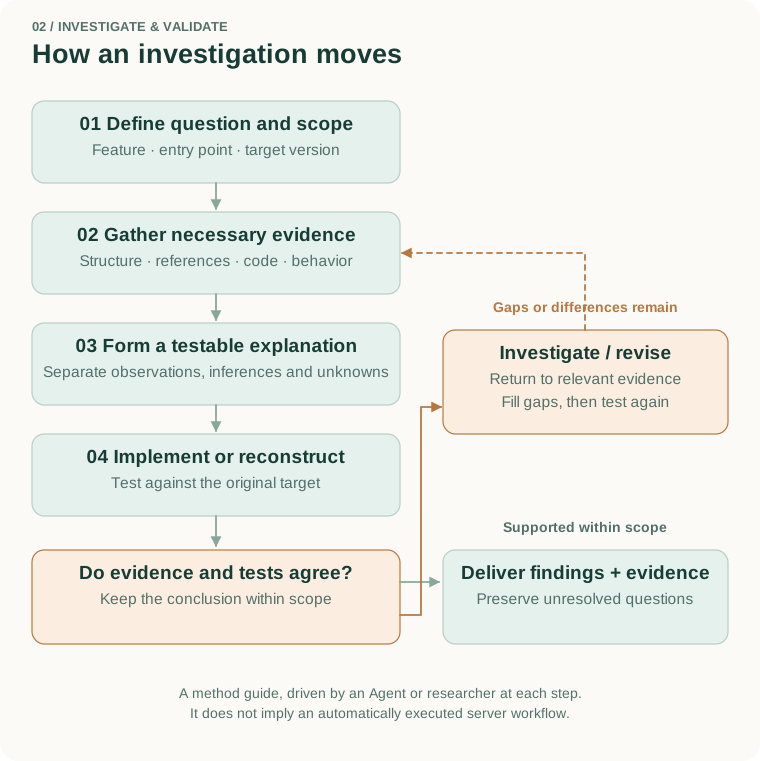
Figure 2. The investigation and validation loop, derived from the project's workflow. The REA server does not automatically execute every step; an agent or researcher still drives implementation and testing.
Follow a feature across application layers
A second strength is making the layers behind a feature part of one investigation. In a modern application, an action can start in the renderer, pass through a preload script and IPC, reach the main process, then invoke an operating system capability. Finding a string with the right name rarely explains the whole feature. REA's Notion case follows this path for clipboard behavior: locating the interface visible to the renderer and its exposure in preload, tracing IPC, then connecting it to the main-process handler and Electron's clipboard API. Notion case study
This makes it easier to connect observations across layers. The agent can relate an interface, wrapper, message channel and receiver instead of drawing conclusions from one isolated code fragment. The case also shows how tools and reasoning complement each other: REA's targeted analysis locates relevant code, while the agent reads wrappers to fill in parts of the connection. The case's module-level validation does not establish that the full desktop UI interaction was tested. The strength is a more traceable explanation of how the feature works.
Preserve the difference between absent and unknown
A third strength is treating “nothing was found” and “this is known not to exist” as different results. That distinction is essential in reverse engineering. An empty caller list might mean a function has no callers. It might also mean that the backend lacks support, analysis is incomplete or coverage is insufficient. If every case becomes an empty array, an agent can easily mistake a tool limitation for a fact about the program.
REA represents these differences in its data model and comparison code. Evidence includes a target digest, provider identity, analysis configuration, operation parameters, raw and normalized results, source categories, limitations and links to other evidence. Function comparisons also check whether the relevant information is actually available. An empty collection without a coverage declaration leaves the associated comparison unknown. Explicitly unavailable pseudocode is not treated as proof that two functions match because both have empty pseudocode. Evidence data model · Function comparison implementation
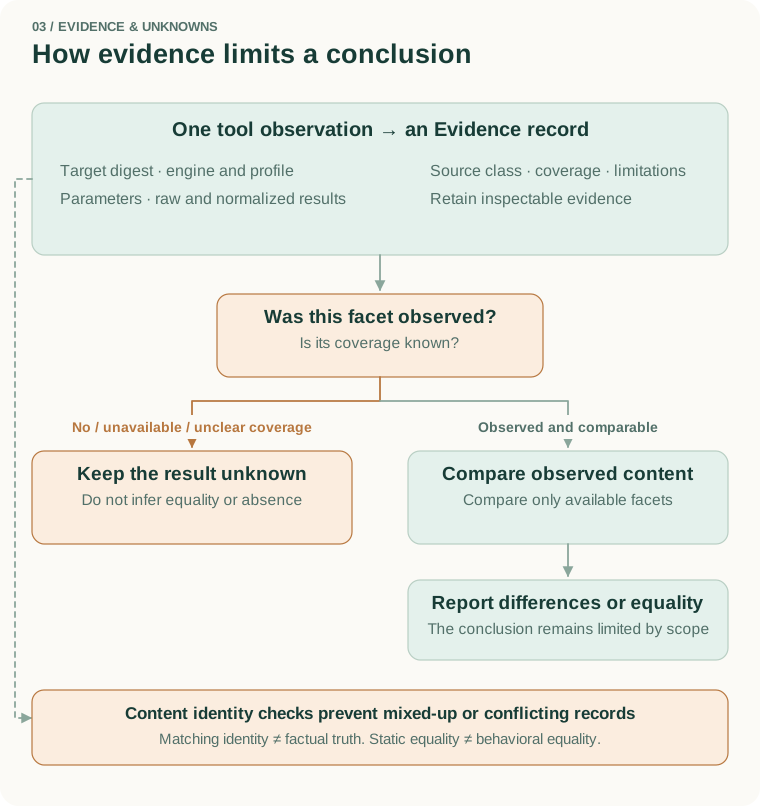
Figure 3. How evidence affects a conclusion. Unknown is a meaningful result; matching static content does not automatically prove matching runtime behavior.
This goes further than attaching citations to an answer. The semantic identity of an evidence record incorporates its analysis content and limitations. The ledger validates records, rejects conflicting content under the same identity and retains the data needed for subsequent queries. A researcher can ask which file a conclusion concerns, which tool and configuration produced it, and which evidence supports it. These mechanisms improve the integrity and inspectability of the record. A content digest cannot itself establish that a decompilation or a model's judgment is correct. Evidence ledger
Control analysis scope and result size separately
A fourth strength is treating the agent's limited capacity to consume information as a tool-design problem. Reverse engineering tools can produce large collections of functions, strings, relationship graphs and source excerpts. A model cannot use all of that effectively in a single call. Wrapping the output in JSON does not resolve the mismatch. Three decisions need separate treatment: how much analysis to perform, how to retain its results and how much to return in this round.
REA's development history offers a concrete example. Issue #1848 records that full-application analysis of an approximately 27.5 MB ASAR could exhaust a 300-second deadline, even though the question concerned only one module. Returning a summary reduces the output but does not automatically reduce the computation that produced it. A subsequent change pushed source or entry selection into the analysis stage and distinguished the selected scope from whole-application coverage. Scope selection controls the work; summaries and pagination control how much there is to read. Both matter. Scoped analysis issue · Implementation pull request
For result delivery, the implementation checks the full response against the default 10 MiB receive-buffer budget of its pinned stdio client version. This is a transport constraint, separate from a model's context window. Oversized responses produce a resource-limit diagnostic. When evidence has been confirmed as successfully retained, the agent can use its reference with inspect_analysis_view to read a summary, a selected part or a page, or export the complete evidence. Retention failures are reported separately. Retention within a session supports continued investigation; long-term preservation still requires an export. Response budget implementation · MCP result contracts
These mechanisms allow a large investigation to proceed over several rounds while retaining a reusable factual basis between them. The expected benefits are less repeated analysis, smaller individual responses and clearer statements of what has not been covered. The magnitude depends on the target and client. It cannot be converted into an unmeasured speedup or percentage of tokens saved.
DX-Ball: test the explanation against the original
The official DX-Ball stereo-pan case puts these strengths into a particularly clear chain of evidence. The first decompilation left a function that appeared to contain little beyond __ftol(), without even presenting its parameters clearly. Interpreting that pseudocode alone would miss crucial information. Further assembly inspection revealed a stack parameter. Following callers established that it represented a horizontal coordinate, and reading constants from raw data made it possible to reconstruct the calculation below. DX-Ball case study
pan ≈ integer_conversion((x × 1.5625 − 500) × pan_scale)
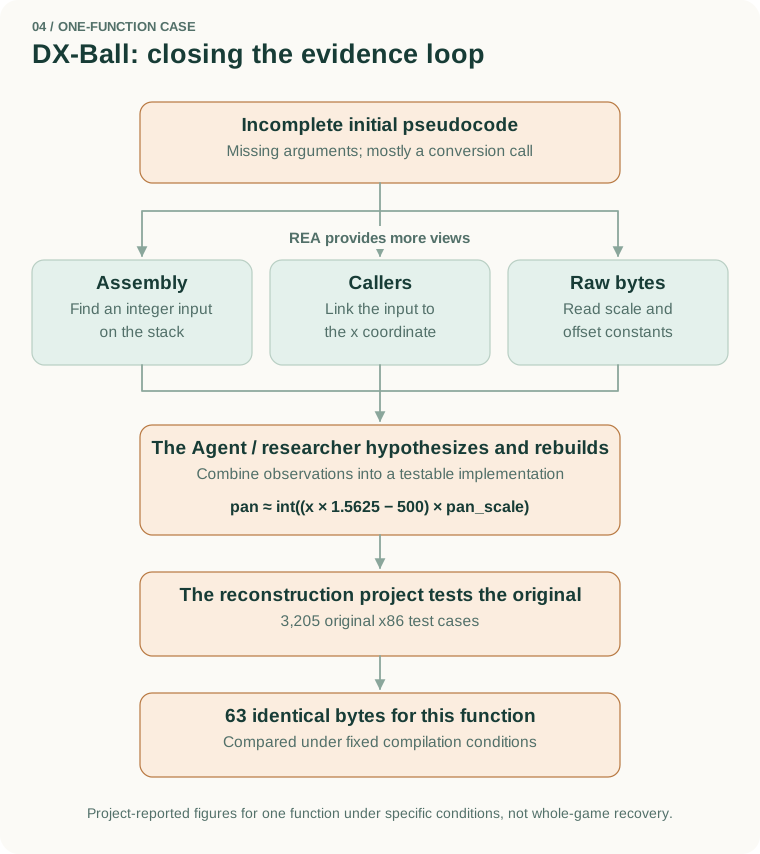
Figure 4. The investigation of one DX-Ball function. The results come from the project's published case record. REA supplies investigation material; the reconstruction project supplies code and validation. This does not establish that the entire game was automatically recovered.
The persuasive part is that the reasoning eventually meets a concrete judge: the original program. Pseudocode, instructions, calling context and constants complement one another; specific inputs and compiled output then test the explanation. The project reports 3,205 comparisons against the original x86 function and a match across 63 bytes of compiled function code. Those results apply to this target, function and set of conditions. They are not a success rate for REA on arbitrary software. The case demonstrates that when a high-level view loses information, the agent can continue investigating through more fundamental evidence.
Five mechanisms that reinforce one another
Taken together, the source code, contracts and cases reveal five complementary strengths:
| Mechanism | Practical difficulty | What makes it useful |
|---|---|---|
| Unified access and a shared workflow | Tool invocation and result formats differ | Reduces the work of connecting tools within an investigation |
| Evidence tracing across layers | A single string or function does not explain a feature | Connects interfaces, modules, process boundaries and underlying implementation |
| Evidence records and coverage declarations | Empty results and missing information invite overinterpretation | Preserves provenance, limitations and unknowns for review |
| Scope selection and selective reading | Analysis and output exceed what the question requires | Controls computation scope and the amount returned in one round separately |
| Validation against the original target | A plausible explanation can still be wrong | Turns some hypotheses into executable checks |
What to trust, and what still needs to be proved
REA's boundaries follow the same mechanisms. “Anything” describes an expanding common entry point; actual capability depends on the target format, host, backend and operation. Some paths support detailed function analysis, some mainly read metadata, and some require additional tools. The 6.5.0 release notes distinguish the conditions under which real tools were verified, including particular local Linux scenarios for Frida and platforms that remain unverified. A capability appearing in a directory does not establish equal maturity in every environment. 6.5.0 release notes
The verification system includes layered tests, paths for checking real providers and some agent evaluations with explicit ground truth. The evaluation code also records its limits. In some scenarios, factualCorrectness remains not_assessed, with heuristic checks for answer characteristics and evidence signals. These checks can assess how tools are called and how answers are formed; they cannot replace factual verification of every reverse engineering conclusion. Testing layers · Agent evaluation judgments · Evaluation coverage
This supports a plausible explanation for the project's appeal. AI coding assistants can already read and organize material, and professional reverse engineering tools can already produce rich observations. REA turns the connections between them—calls, results, state and investigation methods—into a usable product. Whether that caused its popularity remains a product judgment; stars alone cannot establish the causal link. The integration problems it addresses, however, are visible in both the code and the cases.
REA's most useful design lesson is that an agent should be able to keep investigating when information is incomplete, while preserving “unknown” as a traceable state. For reverse engineering researchers, that can concentrate effort on hypotheses and verification. For developers of agent tools, it shows what a good interface should convey: what the model can observe, where the evidence comes from, how much was actually covered, and how to investigate the remaining gaps.