Start with the event: what OpenAI announced
OpenAI DevDay is OpenAI’s annual event for developers and technical builders. Product announcements, live demonstrations, technical sessions and workshops show what people can build with its tools. The 2026 event took place in San Francisco on September 29. Official event overview
This year brought more than 20 updates across ChatGPT, Codex, models, APIs and collaboration. Official recap The main names to remember are dots for ongoing work, Space and Pages for shared artifacts, GPT‑6.1 Sol and Ultrafast for capability costs and speed, and Codex, APIs and plugins for execution and integration. Subscription, sign-in and enterprise announcements shape how those capabilities are used.
Users will want to know what a new assistant or workplace can do for daily tasks. Developers will want to know how models, execution environments and business tools fit together. We start with the announcement landscape, then explain the main shift, costs and a concrete delegation scenario. Community perspectives and official video cues follow.
The announcement landscape in five themes
Group the announcements by their purpose before going deeper. This table establishes the event’s scope; exact names, plans and rollout timing are in the official recap and individual documentation.
| Theme | Main announcements and updates | Problem addressed |
|---|---|---|
| Models and ongoing assistance | Dots, GPT‑6.1 Sol, Ultrafast, Private Intelligence | Capability, speed, continuing work and enterprise data protection |
| Development and execution | Codex Cloud, voice CLI, Code Review, Security Cloud, Decisions API, Agents API with computer use, Bedrock Managed Agents | Investigation, code changes, decisions and checks |
| Plugins and triggers | Plugin extensions, creation and discovery, plugins in Sites, MCP events | Business interfaces and external events in AI workflows |
| Team collaboration | Space, Pages, collaborative slides, shared Team Tasks, Slack/Teams, Meetings, shareable profiles | Shared context, artifacts and follow-up work |
| Subscriptions and ecosystem | Sign in with ChatGPT, Pro 500, OpenAI Marketplace | Identity, allowances, speed tiers and enterprise software purchasing |
Rollout differs by capability. Decisions API starts in limited preview; collaborative slides are planned for the following weeks; Private Inference is a later preview. An announcement is a reason to check your account, region, platform and administrator settings, not evidence that every row is available to everyone immediately. Launch availability
Relate the themes to familiar work: models interpret and generate; execution tools act; business systems supply facts; shared pages hold results; permissions and allowances bound the assignment. That explains why one event spans personal assistants, developer tooling and enterprise collaboration.
The central shift: AI takes on continuing work
An old API is being retired next week. Engineers need to locate its callers, migrate background jobs, preserve customer behavior and chase unanswered questions. After an assistant writes the first plan, much of the coordination and verification is still ahead.
Our reading of these announcements is that OpenAI is assembling models, continuing execution, shared artifacts and business tools into a work system. The key change is carrying an assignment across interactions, changing evidence and collaboration.
The later scenario tests that direction in practical terms: who does the work, where artifacts and evidence live, how costs accumulate and which decisions remain human. Demonstrations give the promise a visible form; those questions help readers decide whether it is useful to try.
A map of responsibilities, artifacts and execution
Dots carry continuing work; Space holds shared context; Pages hold collaborative artifacts. Codex, models and APIs supply execution capabilities, while plugins connect external systems. Their relationship is easier to understand inside one assignment. Official announcement index
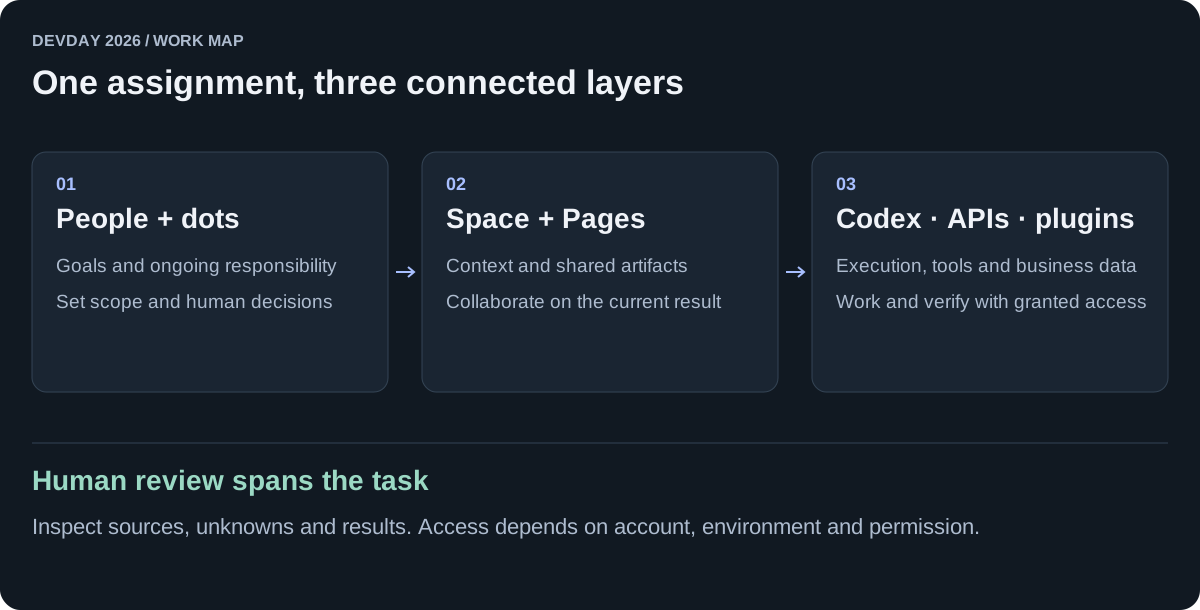
Original Onevium concept diagram. It explains roles, not automatic interoperability or access to every capability.
Work backward from the deliverable. A current migration brief needs test and dependency evidence. Evidence requires access to code and business tools. Following up tomorrow requires a record of unfinished work. Those dependencies determine whether delegation is useful.
Dots need continuing state and bounded authority
Dots run on GPT‑6 Astra, have a cloud computer and can use connected applications to pursue goals over time. Names and characters make the entry point approachable; execution access and context determine what the assistant can actually do. Introducing dots
Rollout is gradual. Pro has age and regional restrictions; Business Premium and Enterprise have their own rollout, with administrator enablement for Enterprise. Dot conversations and delegated Work/Codex tasks have different usage accounting. Continuing work is not unlimited execution. Eligibility and usage
For the migration, a meaningful assignment is to investigate callers, prepare changes and evidence, and keep unresolved questions current. The work record should answer what was found, what remains unknown, which checks must be repeated and who decides next.
The official design restricts unattended proactive-research tools to read-only access. Users control connected apps, rules and approvals, with action review governing consequential operations. Controls and permissions
That gives a trial a concrete question: when a system is inaccessible, does the assistant preserve the missing evidence as unknown, or turn it into an attractive but unsupported conclusion?
Space and Pages make the artifact a shared workplace
Conversation helps people explore. Delivery needs an artifact people can edit, comment on and continue. Space collects shared material; Pages can hold writing, research and visualizations while people and AI collaborate. Official Space overview
A migration project could maintain a caller inventory and release conditions on one page. Engineers add implementation evidence, support adds customer impact, and the owner decides whether the conditions are met. New input should update that artifact with an explanation. Producing disconnected reports leaves integration work with the team.
Sharing an artifact does not share every personal conversation or memory. However, information written into the page is visible to people who have access. Space documentation
At launch, Space and Pages are offered on Pro, Business and Enterprise. Mobile supports finding, reading and sharing; editing and collaborative slides have separate future availability. Availability
Sol and Ultrafast address different costs
Continuing tasks repeatedly read context, call tools and revise results. GPT‑6.1 Sol targets a balance of capability and price: OpenAI reports performance approaching Astra on several evaluations at lower standard token rates. Model announcement
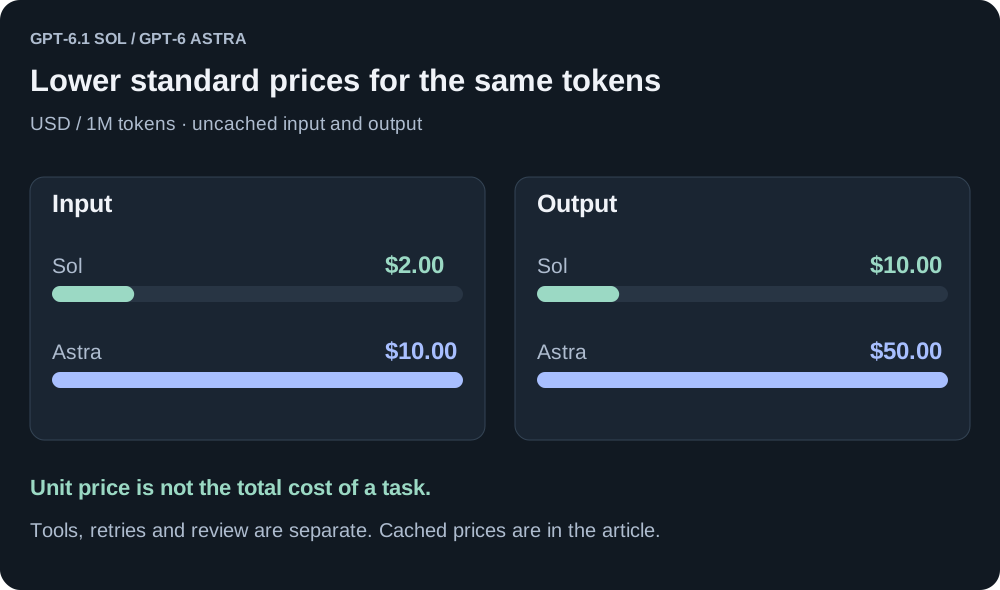
Official standard API prices checked September 30, 2026, in USD per million tokens. Cached input: Sol $0.10; Astra $1.00. Sol pricing · Astra pricing
For a hypothetical task using one million uncached input tokens and 200,000 output tokens, Sol costs 2 + 0.2 × 10 = $4 and Astra costs 10 + 0.2 × 50 = $20. This holds token counts constant; it is arithmetic, not a measured workload. Actual usage, retries, tools and human review change the total.
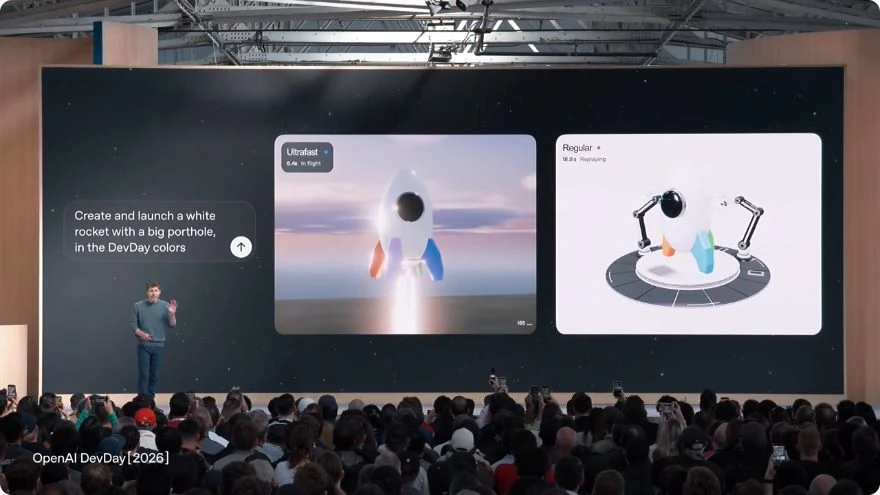
Ultrafast addresses waiting. The keynote presents a side-by-side rocket-building demonstration. The launch recap gives maximum token-generation gains of eight times in Codex and six times in the API. Launch figures Network and tool time remain; the API documentation warns that connection overhead can reduce latency gains. Ultrafast documentation
Treat Sol’s lower unit price and a premium speed tier as separate choices. At launch Sol is offered in Work, Codex and the API, not ordinary Chat; Sol Ultrafast is still forthcoming. Availability
Codex and APIs make the execution system reusable
Codex Cloud runs tasks in their own cloud workspaces, with review and continuation across devices. A task can keep running while a laptop sleeps, but repository setup, dependencies, network access and permissions still require configuration. Codex Cloud documentation
The Agents API exposes a managed Codex harness to applications: sessions, context compaction and recovery, with tools and execution environments. Agents API overview Computer use adds a path for interacting with software interfaces. Computer use documentation
Decisions API is narrower: it chooses among predefined answers from text or image context, for classification, routing or a next action. It launches in limited preview. Announcement
Three questions separate the choices: is this one decision or continuing work? Is execution local or hosted? Do you want an existing development tool or an execution system inside your application? These distinctions help more than calling everything an agent.
Plugins, events and sign-in create new distribution paths
Plugin extensions give external products a place in the sidebar, conversation panels and file viewers. Tools can be accompanied by an interface people operate directly. Surface and plan availability still need checking. Extensions documentation
MCP events add a trigger: an update in a specified project can reach ChatGPT and prompt a response under the user’s instructions. Integration still requires subscriptions, authentication and webhook delivery. Event support does not automatically make every application monitorable. Events documentation
Sign in with ChatGPT connects identity and plan usage to participating tools. Identity sign-in and access to paid usage are separate layers; arbitrary applications do not inherit a subscriber’s allowance simply by offering login. Developer overview
Our commercial interpretation is that OpenAI is reducing execution friction, expanding work entry points and encouraging more delegation inside its platform. Subscriptions provide access, continuing tasks drive usage and premium speed sells reduced waiting. Developers may reduce account and billing friction while becoming more dependent on platform allowances and distribution rules.
The useful differentiator for a business plugin is accurate data, explicit authority and reliable action receipts. An attractive panel can help people use it; the business system still has to support the facts and outcomes.
Use one API migration to test the work system
This is an original, fictional evaluation scenario, not a dots or Agents API run. A store’s inventory API retires next week. The owner asks AI to prepare a migration and reviewable changes; merging, production deployment and customer notifications remain human decisions.
Inputs are an approved repository, old and new API contracts, and specified issue records. The central question is whether inventory behavior survives, not merely whether the URL changes.
| Caller discovered | Behavior to preserve | Reviewable evidence |
|---|---|---|
| Nightly synchronization | A retry does not decrement stock twice | Caller location, diff and retry test |
| Checkout stock check | Out of stock is not treated as available | Error mapping, shortage test and UI record |
| Return restocking | The new contract omits refund/restock ordering | Unknown item, owner and blocked release condition |
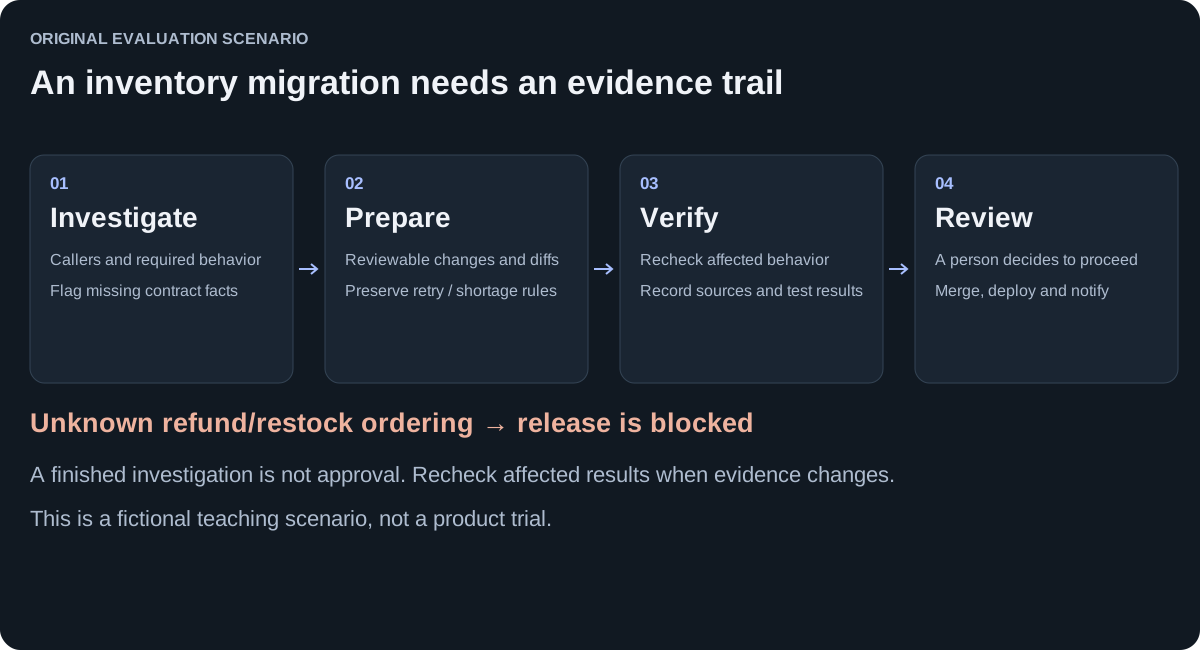
Original teaching workflow. These steps are an evaluation design, not evidence that a product completed this task.
Dots can represent ongoing responsibility, a Space page holds the shared artifact, Codex performs code work and a plugin supplies issue records. Without the third contract detail, a completed investigation cannot justify release. The expected handoff is “two paths have verification evidence; return restocking needs clarification.”
Make the trial discriminating: interrupt access to one source, change a contract requirement, then resume. Check whether unfinished work survives, affected changes are revalidated and blockers remain visible. This examines continuing delegation beyond first-turn generation.
Adapt this assignment to the files and tools your chosen product supports:
Prepare a review packet for the inventory API retirement.
Inputs: the approved repository, old/new contracts and specified issues.
Inventory all callers and required behavior before preparing changes/tests.
Record source versions, evidence, unknowns, owners and next actions.
Keep missing facts unknown; recheck affected results when evidence changes.
Deliver: caller inventory, diff, test record and unresolved questions.
Prepare review only. Do not merge, deploy or notify customers.
Community perspectives and demonstrations worth revisiting
Community coverage is useful for finding questions and selecting visuals; official material remains the source for product facts. Simon Willison’s live blog combines photos, timestamps and observations, including demonstrations that did not go smoothly. The Zenn explanation separates availability, key images and personal interpretation.
Video coverage takes different approaches: CNET offers an approximately 16-minute announcement edit, while Riley Brown’s perspective video focuses on dots and general agent platforms. They are further reading; titles and thumbnails are not evidence of product performance.
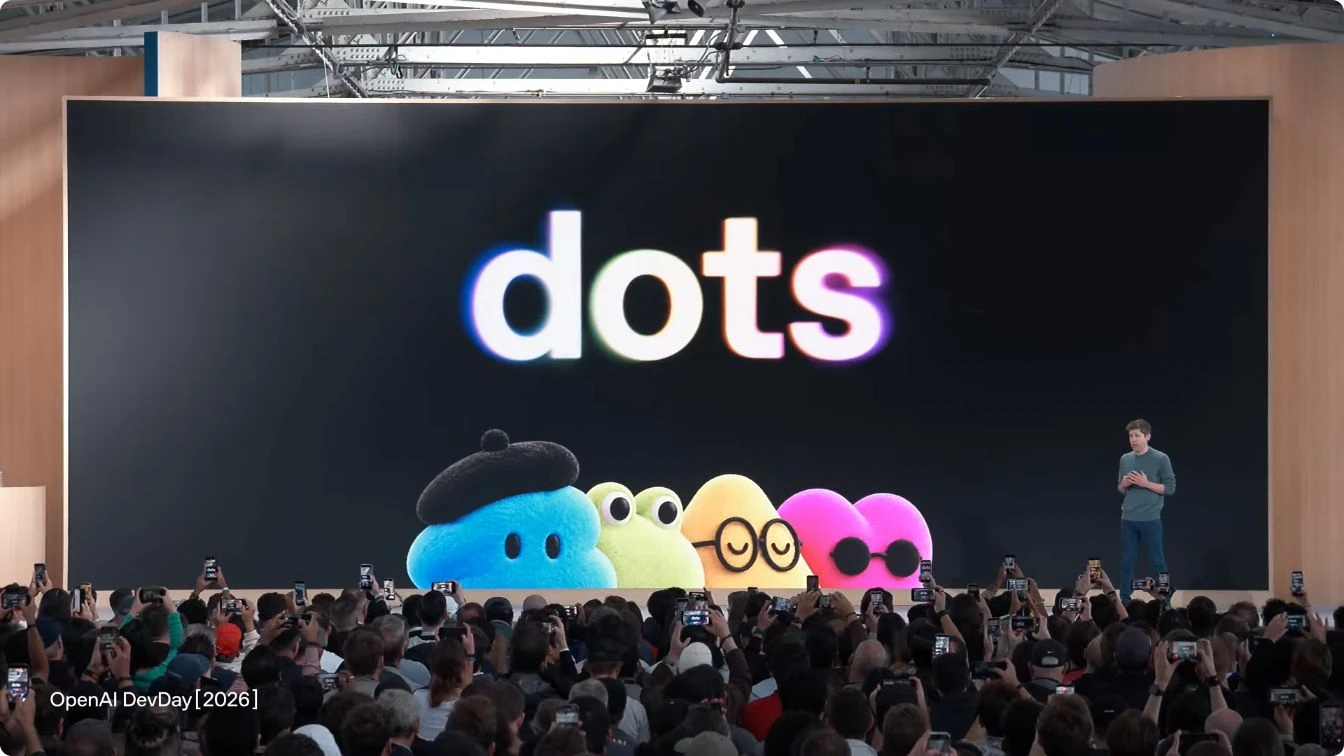
The official keynote’s memorable visuals work best when attached to a specific question. This article excerpts only two frames; the video preserves the full demonstrations:
| Official video cue | What to look for | Question it illustrates |
|---|---|---|
| 02:35 | Dots title and characters | How continuing assistance is presented |
| 08:20 | Introduction to Space | Where context and artifacts live |
| 21:03 | Side-by-side rocket construction | How waiting affects interaction |
| 32:45 | Editing the venue’s 3D model | How instructions become visible results |
| 37:00 | Astra Adventures | How generation and computer use combine |
| 44:30 | Plugins and sign-in | How external products enter the workflow |
These are navigation cues, not a uniform benchmark. A cover invites attention; interfaces and results explain the change; continuing task performance still needs repeated verification.
Judge value by one accepted deliverable
Start with a task that has an accountable reviewer, specified sources and an acceptance standard. Check whether interruptions lose state, changed evidence changes conclusions, and insufficient permission or budget leaves an understandable next step. Broader authority and spending should follow that evidence.
Model pricing helps estimate a trial. Include human review, rework and failed tasks when comparing accepted results. Our workflow value guide develops that method; the Muse and Qwen analysis examines real service access; the Copilot Autopilot analysis focuses on state across time.
For developers, the useful direction is to make data, permissions, action receipts and recovery usable by AI and inspectable by people. For users, it is to specify the goal, authorized scope and completion evidence. Continuing work becomes continuing value when the result is worth accepting.
Sources checked September 30, 2026. This is independent Onevium analysis without OpenAI endorsement. Teaching and cost examples are not product trials. Original diagrams and official video excerpts are identified separately; availability depends on region, account and subsequent official updates.