Qwen could already order lunch. Why did Muse feel exciting again?
If you had already watched Qwen order bubble tea and bring Taobao shopping into a conversation, Meta Muse's demonstrations might have looked familiar. Chinese AI products were already carrying out these tasks. Why did Muse trigger another discussion about an age of personal agents?
Our interpretation is that Muse makes a broader relationship easy to imagine: give an assistant a goal, let it work across services with your context, and receive results as it keeps following up. Shopping is one task within that relationship. Qwen's earlier connection to real consumer services helps explain what makes such delegation possible.
There is a missing fact in the comparison, though: Qwen attracted substantial attention too. The two products became prominent in different markets and at different times, leaving different public impressions. Those differences deserve more attention than a simple claim that the more advanced technology must have won.
There is another part of the appeal: people can start using Muse for free. The allowance lowers the cost of a first experiment; how that service might make money, and affect recommendations, belongs in the analysis too.
How popular? Put the attention back in its market and time
Appfigures' September analysis recorded Muse reaching the top of the US App Store and Google Play charts. It estimated approximately 1.1 million downloads through September 18, predominantly in the US. These are third-party estimates; downloads do not establish retention or successful task completion. Appfigures analysis
Qwen had its own breakout moment. On February 6, the South China Morning Post reported that a drinks giveaway helped it reach the top of China's Apple App Store. Alibaba subsequently reported nearly 200 million orders through Qwen during the Lunar New Year holiday. A chart position and a company's campaign-period transaction figure are different measures; neither should be ranked against Muse's download total. Qwen chart coverage · Alibaba disclosure
The useful question is therefore: why could Muse raise expectations again, even for people who had already seen Qwen act? The following is an analysis of product design and presentation. We do not have a comparable worldwide attention measure or evidence that assigns a precise growth contribution to each factor.
What Muse is: a model inside a system that takes action
Meta launched Muse on September 8, 2026 as a personal AI agent product. Muse Spark is the model powering it. Muse has a cloud computer and browser, accepts messages through its app or WhatsApp, continues tasks after the app closes, and requests approval for actions such as purchases. Meta launch announcement
That separates three frequently blurred concepts. A model interprets a request and selects a next step. Tools let it read pages, call services and modify files. The surrounding product preserves task state, manages accounts and permissions, arranges follow-up work and presents results. Better reasoning alone does not provide a merchant's transaction API or resolve an uncertain payment.
“Personal” has a practical meaning too: the work uses your budget, preferences and existing commitments, and relevant context can carry into later tasks. A name and an avatar cannot provide this on their own. People need ways to inspect and correct memory and decide when action is allowed.
Four reasons Muse could create another breakout moment
First, the outcomes are easy for people outside technology to value. Saving an expense, completing a booking or resolving an overdue chore has a clear before and after. Someone can decide whether they would delegate that task without understanding model benchmarks. Such examples make the benefit legible, although an individual demonstration cannot establish general reliability.
Second, follow-up work changes the relationship. Muse's design account shows continuing tasks, activity records and purchase approval cards, with notifications for meaningful developments or decisions. Memory, progress and approval become visible parts of the interface. Muse product design In our reading, that makes an ongoing assistant easier to imagine: something that will need attention tomorrow can be delegated today.
Third, familiar entry points make trying it more approachable. A consumer messaging interface and the WhatsApp entry point offered at launch remove the need to begin by setting up an execution environment. Meta's consumer reach also belongs in an explanation of distribution. Reach does not ensure conversion, however, and a messaging integration does not automatically grant access to all a person's accounts. Launch access details
Fourth, follow-up announcements expand the product's perceived scope. The September 23 Connect event and the next day's official summary described more connectors, voice and shopping capabilities, with AI glasses integration planned for the coming months. This extends the imagined interaction from a phone task to something a person sees around them. Those announced additions still need to be understood according to their rollout status. Connect 2026
Together, these factors give Muse strong conditions for attention: understandable benefits, an ongoing delegation relationship, everyday access and room for expansion. The evidence does not isolate a unique technical invention as the cause, or show that lasting adoption has already followed.
What Qwen had already accomplished—and why its impression differed
Qwen's January 15 upgrade entered public testing in China with Taobao, Taobao Instant Commerce, Alipay, Fliggy and Amap integration. The launch demonstrated ordering 40 bubble teas, with explicit confirmation required for in-chat payment. Natural-language access to real services was already concrete before Muse launched. January announcement
In May, Alibaba announced access to Taobao's full catalog in the Qwen App. The same announcement described comparison and promotion features in the Qwen Shopping Assistant inside the Taobao App. Features should be attributed to the product in which they were announced. May announcement
Qwen's strength here is substantial: products, merchants, payments and delivery already exist, and AI can coordinate actions previously spread across pages. The holiday campaign compressed a first experience into a very understandable activity: claim an offer and buy a drink. That is effective distribution, and it can also make drinks, coupons and Alibaba's consumer ecosystem the first things people remember.
Muse's presentation of longer-term goals and work across applications invites a broader question: how much of my future administration could this assistant handle? This is an interpretation of the products' public presentation, not a survey of their users. It does not restrict Qwen to shopping or establish that Muse can operate on every service. For an actual purchase in China, a working order and fulfillment system may matter more than an expansive vision.
Muse is free. How could Meta make money?
Free access belongs at the center of the business analysis. The official FAQ describes a free usage allowance: after reaching it, users can wait for a refresh or upgrade to a paid subscription. Free access is the entry point; paid capacity is already an announced revenue path. Muse FAQ
This matters for attention as well. A convincing demonstration followed by “try it for free” shortens the distance to a first delegated task. Our interpretation is that Meta can use an allowance to encourage a habit: when something needs doing, tell the agent first. Repeat delegation, retention and successful outcomes will show whether that habit develops.
Meta's advertising background makes the question consequential. Its second-quarter 2026 release reports advertising revenue of $59.363 billion against $60.801 billion in total revenue: approximately 97.6%, calculated from those figures. That is context for the group's incentives. Meta's earnings release
Our stronger thesis is that personal agents could move commercial competition from capturing attention toward participating in decisions and completed transactions. A feed predicts interests; a request for a hotel this weekend within a stated budget already contains a practical intention. A product trusted to complete that request sits close to a buying decision. This is our interpretation of the opportunity.
Three revenue paths deserve separate treatment:
| Path | Commercial logic | Evidence today |
|---|---|---|
| Subscriptions and extra usage | Frequent users pay for capacity; revenue helps fund computation and execution | Free allowances and paid upgrades are announced. Conversion rates and profitability are unknown |
| Merchant referrals or transaction fees | Qualified orders and customers may be valuable to service providers | A hypothesis. Payment integration alone does not establish a commission agreement or its rate |
| Clearly labeled sponsored recommendations | Relevant commercial candidates could support an advertising product | A hypothesis. The materials checked do not establish that Muse has launched this model |
There is also a strategic reason to participate: if people increasingly express needs through agents, Meta has an incentive to remain an entry point, and merchants have an incentive to be discoverable there. That potential cannot be booked as current Muse revenue.
An advertising discussion also needs the existing commitment: Muse's official page says conversations are not shared with Meta's advertising systems. Official product and privacy information The group's revenue mix does not demonstrate that private Muse tasks are being used for ad targeting. A future sponsored product would need its own explanation of data use, commercial labels and permissions.
Free service has real costs. Browsing, inference, retries and continuing execution consume resources. Subscription receipts and any future revenue must be evaluated against acquisition, operating and service costs. A large user count or transaction value alone says little about profit.
Qwen provides a useful comparison. Alibaba's existing products, payment and fulfillment systems can already absorb some consumer demand; promotions helped people reach a first transaction. Muse's free entry point may encourage delegation across a wider range of personal tasks. In our view, both are competing to become the place where a person first expresses a need, with different service foundations and adoption paths.
Consider the fictional quotes later in this article: eligible offer B costs RMB 130; A costs RMB 139. If A hypothetically paid a referral fee, a trustworthy assistant would still need to explain its choice against the user's criteria and disclose the commercial relationship. A durable business depends on users trusting that their budget, preferences and approval continue to govern the task.
How an ecosystem comes together: services, web pages and permission
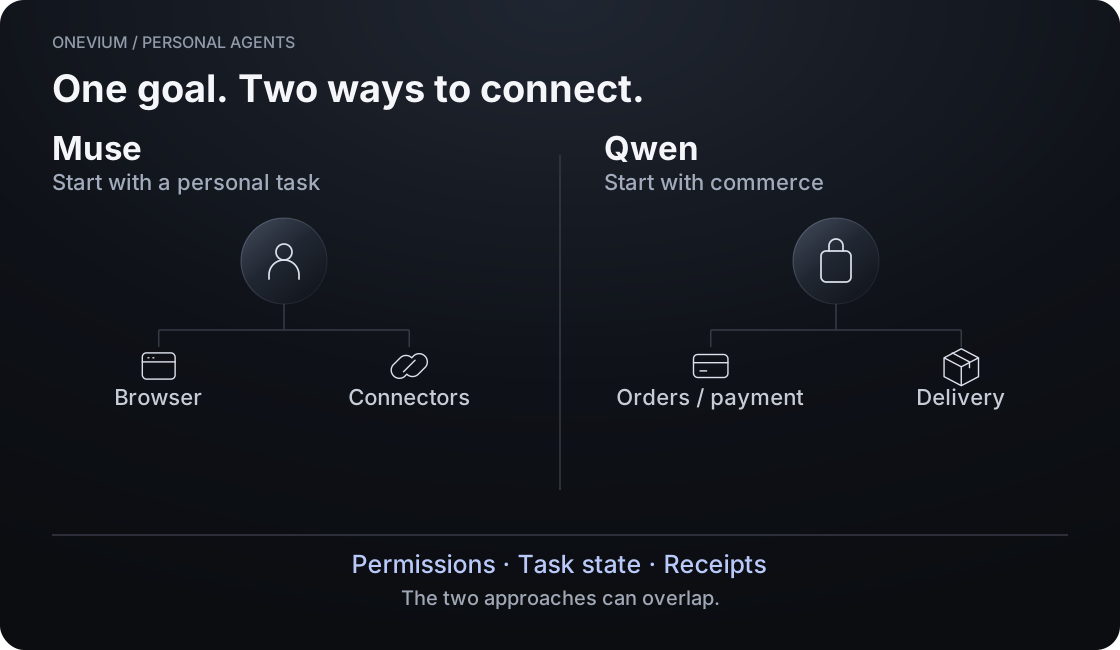
Original diagram. The routes can overlap; they show the main starting points in the public material.
Connectors use a service's interfaces to obtain data or perform actions, such as checking stock or creating a calendar event. A browser can find information and fill forms on existing pages. Interfaces generally return clearer fields; browser access can cover more existing sites while encountering page changes, sign-in requirements and restrictions. Both require account permissions and verification of what actually happened.
Much of the difficult work happens between tools. “Order Friday lunch for eight” must become quantities, dietary requirements, an address and a deadline that services accept. Prices, stock and delivery coverage must become a proposal. An approval must then correspond to a particular order. Models, service interfaces, payments and fulfillment each handle part of the job.
Service participation also affects coverage. Axios reported on September 21 that Amazon had blocked Muse shopping. Report Product builders should treat usable access as a concrete dependency. Users should check whether an agent connects to the services they actually need.
What should people learn to expect after Muse?
A useful higher expectation is that a task can continue across multiple conversations. Judgment needs to develop alongside that expectation: after seeing a successful demonstration, ask what information was available, what action was authorized and how the result was verified.
| Understanding to develop | A concrete instruction | What to inspect |
|---|---|---|
| Delegate a goal with conditions | Eight lunches by Friday 12:15, at most CNY 240 in total | Quantities, dietary needs, deadline and all fees |
| Maintain personal context | I am not a new customer; two guests are vegetarian | Accurate eligibility and current preferences |
| Give permission for specific actions | Research options; show me the order before payment | Merchant, amount and order covered by approval |
| Require evidence of completion | Return the order ID, charged amount and delivery status | A real receipt behind “arranged” |
| Expect follow-up and recovery | Check order status after a payment timeout | Preserved state and protection against blind retries |
Writing a longer prompt is only part of this. Stating conditions, recognizing missing information and checking evidence become everyday skills for using a personal agent. People can perform fewer page operations while retaining control over the goal and consequential decisions.
A price comparison makes “understands me” concrete
Here is a fictional teaching example with no real purchase. The requirement is a U60 adapter supporting 4K at 60Hz. All charges are listed in CNY, and the buyer is not a new customer.
| Offer | Specification | Price | Shipping | Promotion | Eligible total |
|---|---|---|---|---|---|
| A | U60 / 4K 60Hz | 129 | 10 | 20 off for new customers; ineligible | 139 |
| B | U60 / 4K 60Hz | 145 | 0 | 15 off for everyone | 130 |
| C | U30 / 4K 30Hz | 119 | 8 | None | Excluded: wrong specification |
B is the cheapest eligible choice among these three offers: 145 − 15 = 130. A cannot use the new-customer discount. C's total of 127 does not satisfy the requirement. Delivery dates are still missing, so the comparison cannot establish arrival before the event.
Personal context has a measurable role here: knowing the buyer's eligibility changes the correct total. Following through means checking price and stock again before payment and resolving the delivery question. Reading the lowest number does not fulfill the purchasing request.
Save the table as offers.md in a local project and ask a Onevium conversation to produce comparison.md:
Filter offers.md for a U60 adapter with 4K 60Hz support.
I am not a new customer. Show applicable discounts
and the total-price formula for each offer.
Cite offer IDs for each judgment and list missing information.
Produce only the comparison file, keeping decisions for my review.
The expected answer is A=139, B=130, C excluded, and delivery unconfirmed. This uses the workspace Markdown capabilities released in Onevium 1.2.2. It is a manually checkable exercise, with no claimed model trial or transaction integration. Release · Projects and sessions · Files, terminal and Review
What kind of era is beginning?
A useful description is the early stage of personal agents becoming an entry point to everyday services. That is a direction inferred from current products: people delegate goals to an assistant, which coordinates applications that still supply data, services and fulfillment. Several capabilities must work together; neither Muse nor Qwen establishes that the entire transition is complete.
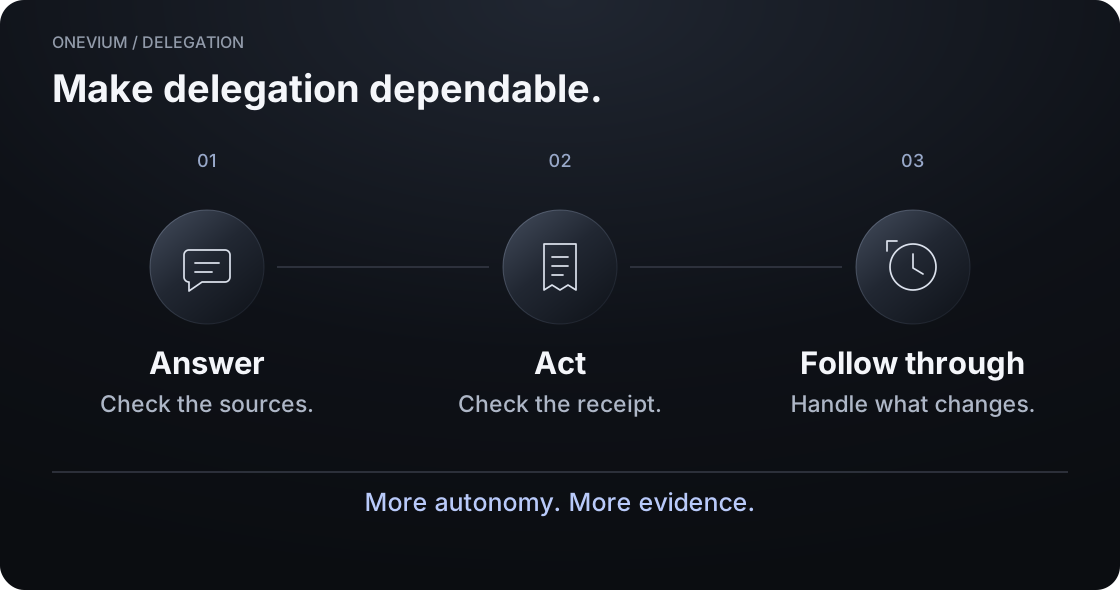
Original analytical framework for understanding a delegated task, not a generation ranking of vendors.
For users, routine administration becomes a set of goals that may be delegated. Service providers need ways for authorized agents to understand products, obtain reliable status and act. Agent products increasingly have to compete on accurate context, useful service coverage, recovery from failure and whether people continue to grant access.
Commercial relationships matter too. When an assistant compares candidates, how does it rank them? Which results are sponsored? What responsibility belongs to the service and to the assistant? The answers affect whether people trust a product to act for them.
There are already concrete approaches to permissions. Meta's technical account separates Muse's execution from credential handling, with Sentinel deciding whether actions may proceed. The stronger Confidential VM remained a future plan at launch and should not be confused with the available Secure VM. Official security architecture
Muse's attention makes continuing delegation visible to more people. Qwen's transaction experience shows the importance of real service integration. Repeated ordinary tasks will determine how far the next stage goes: were the conditions met, were exceptions handled, and is the result good enough to delegate again?
Sources checked through September 27, 2026. Explanations of attention and future direction are independent analysis. Feature access depends on regional and account rollout.